


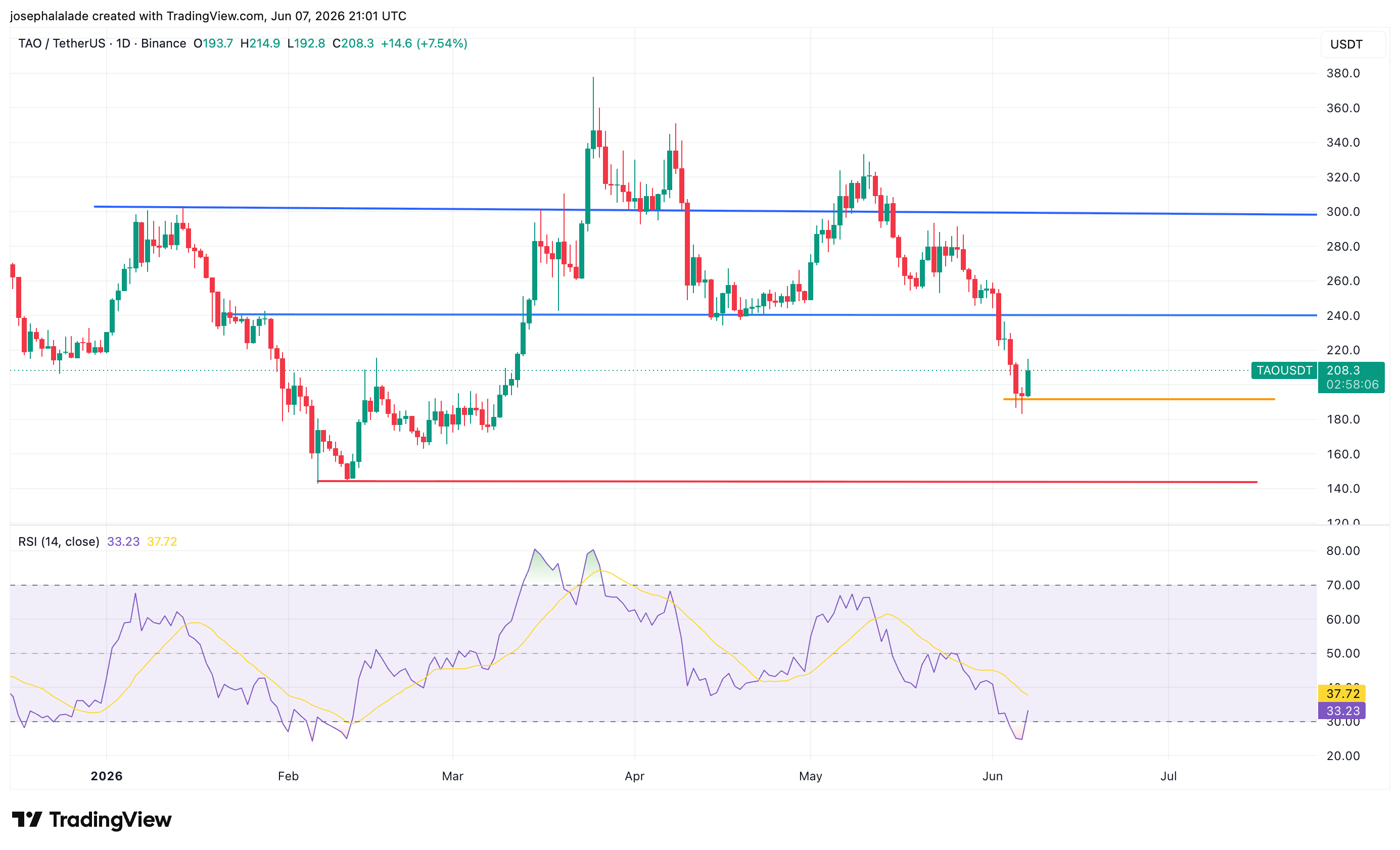
Bittensor (TAO) traded around $206 on Monday morning after rebounding 6.6% over the past 24 hours. The token recovered from an intraday low near $193 and briefly reached $215 as buyers stepped in following weeks of sustained selling pressure.
The rebound comes after TAO completed a bearish breakdown from a trading range that had contained price action since April. The Bittensor token spent much of the past two months oscillating between support near $240 and resistance around $300 before finally breaking lower.
Despite today’s bounce, the broader trend remains under pressure. TAO is down more than 19% over the past week, 32% over the past month, and roughly 73% below its all-time high near $760. Major moving averages continue to point lower, with the 200-day EMA at around $270, acting as a significant overhead resistance.
From a technical perspective, the most notable development is momentum exhaustion. The daily Relative Strength Index recently fell below 30, marking one of the most oversold readings seen during the current market cycle. Previous oversold conditions have coincided with significant recovery rallies, although such signals alone do not confirm a trend reversal.
Also, momentum indicators continue to reflect heavy selling pressure, but the intensity of the decline appears to be slowing. For bulls, the next challenge is proving that the current bounce is more than a temporary relief rally.
Bittensor Network Activity Builds as Subnet Revenue Grows
While the chart remains weak, Bittensor’s fundamental story continues to expand.
The decentralized AI network now supports 128 live subnets and is moving toward a long-term goal of 256. Several subnets have begun generating measurable economic activity, including buyback programs, enterprise pilots, platform revenue, and infrastructure efficiency gains.
The ecosystem has also expanded into areas such as drug discovery, wildfire detection, language translation, distributed AI model training, and weather forecasting.
Institutional interest remains another area of focus. Asset managers, including Grayscale and Bitwise, have submitted ETF-related filings tied to the token, while prominent industry participants, such as Barry Silbert, Digital Currency Group, and Yuma Group, have continued to build exposure to the ecosystem.
For traders, however, price remains the ultimate judge. The key level to watch is $240. That former support zone now acts as resistance after the recent breakdown. A successful reclaim could open the door toward $260 and eventually $300.
Failure to recover $240 would keep sellers in control and increase the risk of another move toward the $190-$200 region. If that support breaks, the next major levels are near $165, with the February lows around $140-$145.
Buyers have successfully defended the first test near $192. Whether they can reclaim $240 will determine if this rebound develops into a genuine recovery or remains another lower high within the broader downtrend.
READ MORE: Zcash Price Recovers After 50% Crash – Is a Bull Trap Forming?