



- A stock market crash is happening, erasing trillions of dollars in value.
- The retreat accelerated after the US published strong non-farm payrolls data.
- There are concerns about the relentless fundraising to fund AI projects.
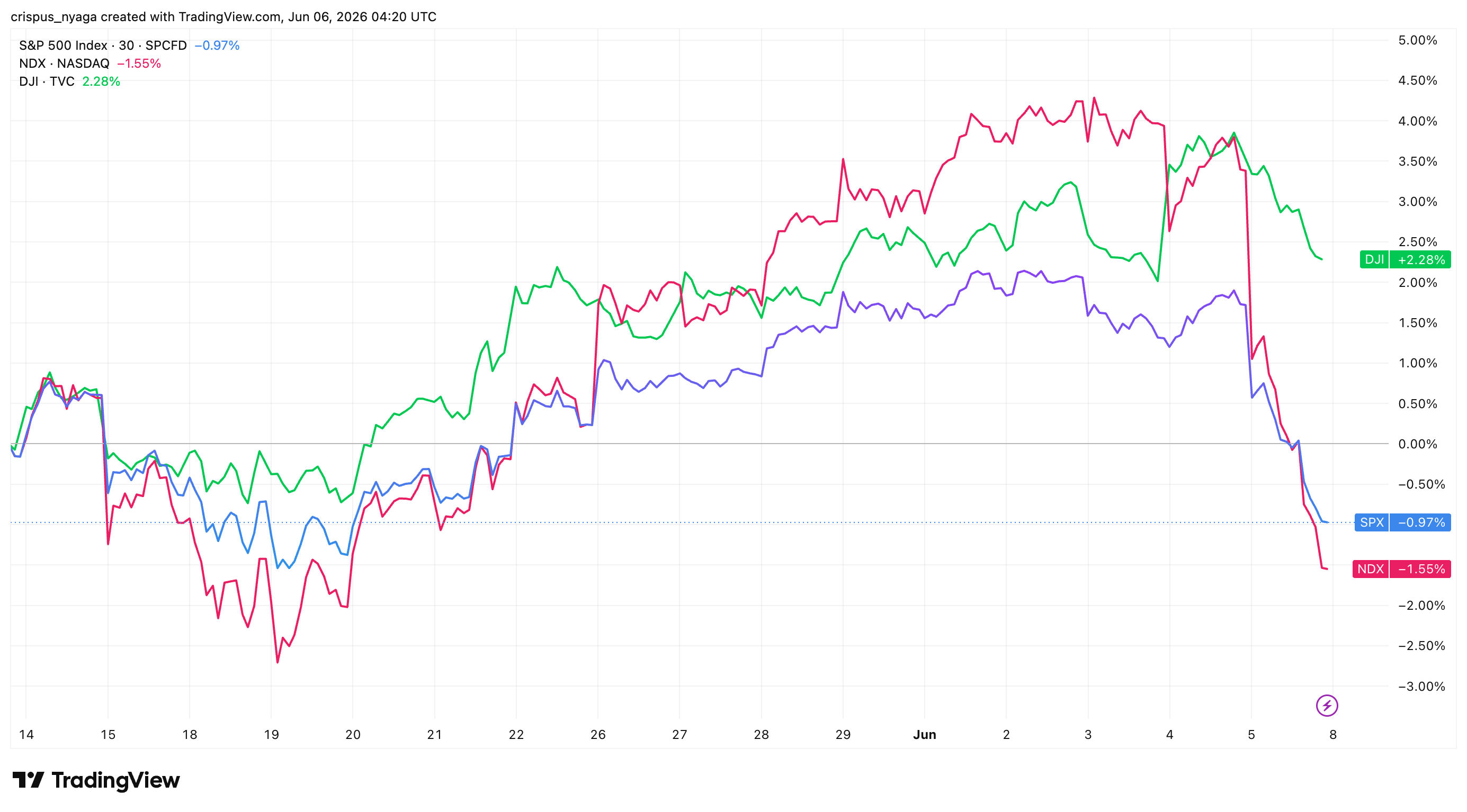
A relentless stock market crash is happening, with the top US indices like the Dow Jones, Nasdaq 100, and S&P 500 erasing trillions of dollars in value. The Nasdaq 100 Index ended the week at $28,957, down from over $30,000. The S&P 500 and Dow Jones have fallen by over 2% from the YTD highs.
Why the Stock Market Crashed
The S&P 500 Index tumbled by over 3%, while the Dow Jones and Nasdaq 100 fell by 1.35% and 5.6%, respectively from their highest points this week. This retreat erased trillions of dollars in value, with technology names like Broadcom, NVIDIA, and AMD being the top laggards.
There are a few reasons why the stock market crashed. First, the Bureau of Labor Statistics (BLS) published a strong non-farm payroll (NFP) report, which showed that the economy created 172k jobs, higher than the median estimate of 85k.
More job numbers released this week were fairly strong. ADP reported that the private sector added over 122k jobs, while the BLS revealed that the number of jobs vacancies jumped by over 700k.
With inflation remaining above the Fed’s 2% target for over five years, investors are concerned that the Federal Reserve will start hiking interest rates this year. The base case calls for 2 hikes this year.
Second, the S&P 500, Nasdaq 100, and Dow Jones are falling amid a flood of share sale by big technology companies to fund their AI ambitions. Alphabet and Meta Platforms are raising nearly $200 billion, combined, for this. It is common for stocks to drop whenever there is such a massive dilution.
READ MORE: DRAM Stock and AUM Are Surging: Time to Buy This Sandisk, Micron, SK Hynix ETF?
Third, massive IPOs are happening this year, including SpaceX, OpenAI, and Anthropic. Combined, these IPOs will raise billions of dollars, with the combined valuation soaring to over $4 trillion. With the SpaceX IPO happening next week, there is a likelihood that some investors are selling already expensive shares and cryptocurrencies to position for the event.
Additionally, the stock market crashed after the latest Broadcom earnings on Wednesday. The company, which is a major player in the AI industry, released a weak forward guidance, triggering a sell-off across top AI names
At the same time, the ongoing stock market crash happened as the top indices were extremely overbought. Their Relative Strength Index (RSI) was at an elevated level before the crash happened.
Will the S&P 500, Nasdaq 100, and Dow Jones Recover?
The question among investors is whether the S&P 500, Nasdaq 100, and Dow Jones will bounce back after this crash. History shows that these shakeouts are common during bull markets, and equities always bounce back.
Technically, there are signs that stocks will drop further in the near term, and then rebound. For example, the S&P 500 Index may drop to $7,000, its highest point in January, and then rebound. This is known as a break-and-retest pattern, which is a common bullish reversal sign in technical analysis.
One reason why the stock market may drop further in the near term is that the SpaceX stock will likely drop a few days after its June 12 IPO. This is what most IPOs, including Circle, Figma, and Cerebras, did after going public.
READ MORE: Are the Kospi, Nasdaq 100, and Nikkei 225 Indices Contributing to the Crypto Crash?