


The Dow Jones Index crashed below a crucial support level on Monday as the stock market dived amid rising risks. It dropped to $48,800, its lowest level since February 5, and was nearly 4% below its all-time high. This article explores why the DJI Index is slumping and why it may have further downside.
Top Reasons Why the Dow Jones Index is Slumping Today
There are four main reasons the Dow Jones Industrial Average is slumping this week. First, there is the ongoing confusion around Donald Trump’s tariffs. The Supreme Court ruled against his tariffs on Friday, prompting him to announce new tariffs under an existing, limited law.
Therefore, there is uncertainty about the tariffs the US will levy on other countries and their impact on American companies, including those in the Dow Jones.
READ MORE: BMNR Stock Analysis: Top Reasons Why BitMine Will Go Parabolic
Second, the index is falling as investors wait for Trump’s final decision on striking Iran. The odds of an attack in the coming weeks have soared on Polymarket. Also, Trump has given Iran a few days to reach a comprehensive deal.
A new war in the Middle East would have major impacts, including soaring crude oil prices and supply chain disruptions. It would also lead to more volatility in the financial market.
Third, market participants are positioning themselves for NVIDIA’s earnings, which will be released on Wednesday. These results matter to the Dow Jones because it is the Index’s largest constituent. Also, NVIDIA’s results will provide more color on the health of the artificial intelligence (AI) industry.
The index is also slumping amid fears that some constituent companies, such as Microsoft, IBM, and Salesforce, will be disrupted by AI technology. This explains why the IBM stock price tumbled by over 10% on Monday, its worst daily performance in decades.
There are also concerns about the private credit industry, where stocks like Blue Owl, Ares, and KKR have tumbled in the past few weeks.
DJI Index Technical Analysis
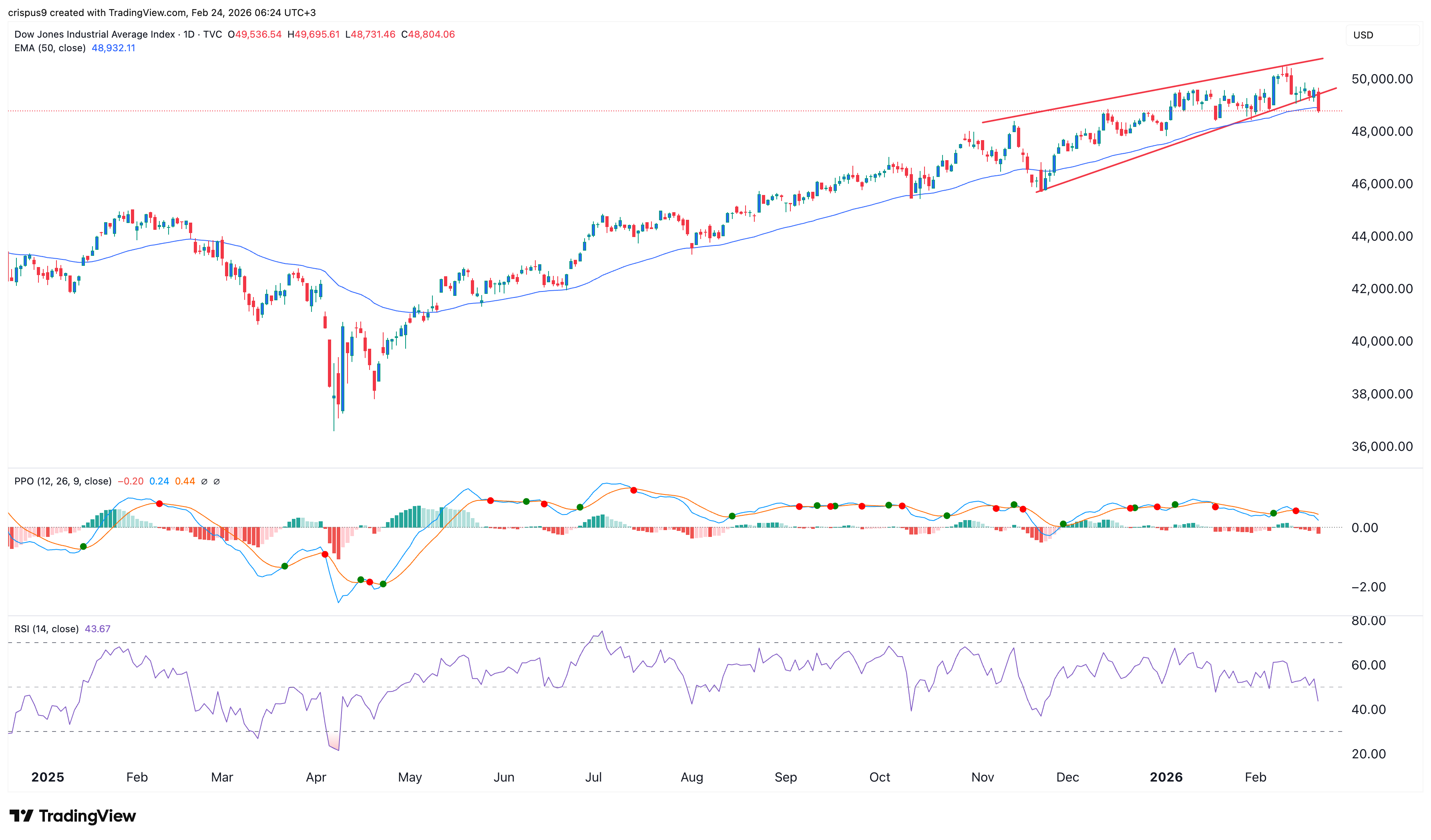
Technicals also explain why the Dow Jones Index has slumped this week. A closer look shows that it formed a rising wedge pattern, a pattern made up of two converging trendlines. This pattern often leads to more downside over time.
The index also retreated after forming a bearish divergence pattern. This pattern typically forms when the key oscillators, such as the Relative Strength Index (RSI) and the Percentage Price Oscillator (PPO), retreat as an asset rises.
Therefore, the most likely scenario is that the index continues to fall, as it has now moved below the 50-day moving average and the lower side of the wedge pattern. This retreat may see it drop to the key support level at $48,000.
READ MORE: CoreWeave Stock Faces Tailwinds and Risks Into Earnings