


- PayPal stock has a forward PE ratio of just 8, much lower than the S&P 500 Index average of 19.
- The company is one of the cheapest fintech stocks in the market.
- However, the company may be a value trap amid weakness in its branded business.
PayPal stock price has moved sideways in the past four years, even as the broader stock market has soared to a record high. PYPL was trading at $45.35 on Monday, down substantially from the all-time high of $300.
Its valuation has slumped from over $300 billion to $41 billion. The PayPal share price has become a bargain in various ways. So, will it rebound or continue falling?
PayPal Stock Price Has Become a Bargain
Data shows that PYPL stock has become a bargain this year, plunging from a high of $300 a few years ago to its current $45.
For example, the company has a forward price-to-earnings ratio of just 8.5, which is well below the five-year average of 21 and the sector median of 10. In contrast, the S&P 500 Index has a forward multiple of 19.9, while the Nasdaq 100 Index has a multiple of 21.
The company is also a bargain in other multiples, including the forward EV-to-EBITDA, which has dropped to 6.5, below the five-year average of 15. These multiples are much lower than those of other fintech companies, such as Block, Shift4 Payments, and Visa.
In addition to being highly undervalued, the company is also rewarding its investors, with management spending billions of dollars to buy back its shares. It repurchased shares worth over $1.5 billion in the fourth quarter, bringing the annual repurchases to over $6 billion.
Share buybacks are usually bullish because they reduce the number of shares in circulation, thereby increasing earnings per share (EPS). The company also began paying dividends at $0.14 per share. PayPal also has a solid balance sheet with over $14.6 billion in cash and $11.6 billion in debt.
Still, despite these solid metrics, there are signs that the company may be a value trap, as its business is facing major headwinds, which explains why it recently replaced its CEO.
The main challenge is that PayPal is no longer a growth company, with the most recent results showing that its active accounts grew by just 1% to 439 million, while its revenue rose by just 3% to $8.6 billion.
READ MORE: Ethereum Price at Risk as Key DEX Metric Plunges Amid Hyperliquid Boom
This performance is happening as its branded business continues to experience major challenges, with competition coming from popular companies like Google, Amazon, and Apple. Fewer people are clicking “Pay With PayPal” these days, with many opting for BNPL companies like Affirm and Klarna.
PayPal’s stablecoin business is also struggling, with the PYUSD supply falling to $3.9 billion and its transaction volume falling to $17.2 billion in the last 30 days. In contrast, the USDC stablecoin handled transactions worth over $6 trillion in that period.
Therefore, while PayPal stock is a bargain, the company lacks a clear catalyst to boost near-term growth. A potential one is the potential bid from Stripe, a private community valued at over $150 billion.
PYPL Stock Price Technical Analysis
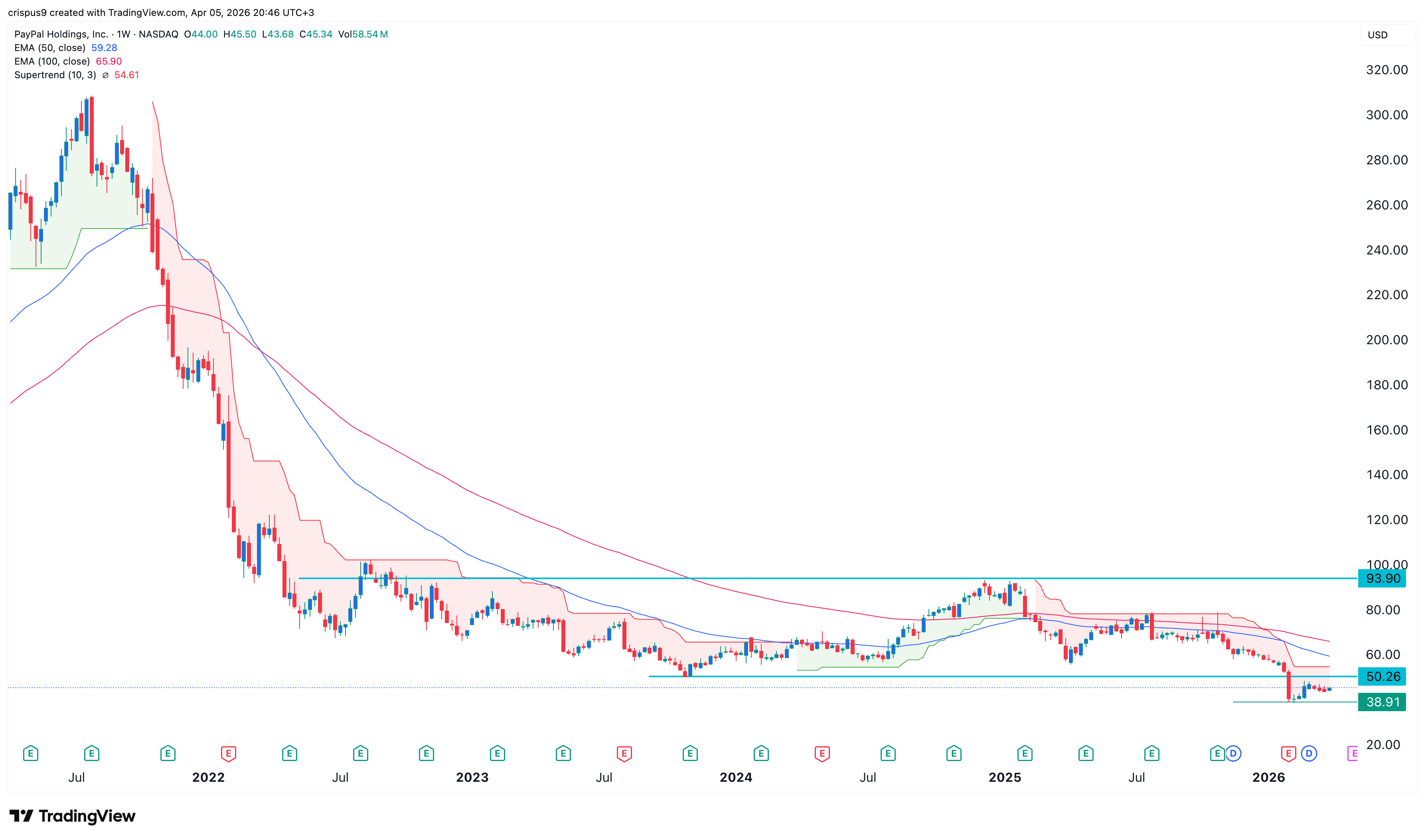
The weekly timeframe chart shows that PYPL stock price has traded horizontally since 2022.
It has remained inside the narrow channel between the support and resistance levels at $50 and $93. It recently fell below the important support level at $50, reaching a low of $38.9.
The stock remains below all moving averages and the Supertrend indicator, a sign that bears remain in control. Therefore, barring a major announcement such as an acquisition, the stock will likely continue falling in the near term, potentially to the key support level at $35.
However, the ongoing consolidation could signal that it is in the accumulation phase of Wyckoff Theory, which may lead to a strong bullish breakout. A good example of this is Fastly, which remained in a narrow range for years before rebounding this year.
READ MORE: Here’s Why the Pi Network Coin Price is in a Freefall and What Next