



- Coinbase stock does not pay a dividend as the company focuses on growth.
- The management prefers to use extra cash on share buybacks.
- The CONY EFF pays a large dividend but has a catch.
Coinbase stock remains in a bear market after falling by over 55% from its peak last year, a decline that has coincided with the ongoing crypto winter. This article explores whether the 72% yielding CONY is a better buy.
Coinbase Pays No Dividend, But CONY Does
Coinbase, like many technology companies, does not pay dividends despite substantial profits. The most recent results revealed that the company made $6.8 billion in annual revenue last year and a net profit of over $2.57 billion.
Coinbase prefers to use its free cash flow to repurchase its stock, a move intended to boost earnings per share (EPS).
It repurchased 3.3 million shares, valued at over $850 million, in the fourth quarter. It has repurchased shares worth $1.7 billion, helping offset dilution from its share-based compensation. Also, it recently launched a new $2 billion repurchase.
Still, investors interested in earning a dividend from Coinbase will likely have to wait longer as the company is still investing in its growth.
Instead, income investors who are bullish on Coinbase stock may want to consider the YieldMax COIN Option Income Strategy ETF (CONY), which pays a variable but high dividend yield of over 70%.
CONY achieves this by leveraging the concept of covered calls, in which a fund manager uses cash to buy an underlying asset and then takes a call option on the same asset.
In this case, the fund buys a stake in derivatives tracking Coinbase shares and then sells call options on the same. This approach helps it to capture the option premium, which rises in periods of high volatility, and distribute it to investors.
READ MORE: Cardano Price Eyes Rebound Despite Falling Chain Fees
Is CONY Better than COIN Stock?
In theory, CONY seems like a much better investment than COIN because of its high dividend yield and its tracking of the main stock.
However, in practice, the best metric for assessing an asset’s performance is total return, which considers stock performance and dividends.
Covered call ETFs like CONY have often outperformed the underlying asset when its stock is falling or trading in a tight range. They then underperform by a wide margin when the stock is rallying.
For example, CONY’s total return this year is -9.42%, while COIN has dropped by 12%.
In the long-term, however, covered call ETFs often underperform the underlying asset. For example, as the chart below shows, COIN stock has risen by 4% over the last 12 months, while CONY has dropped by 15% over the same period.
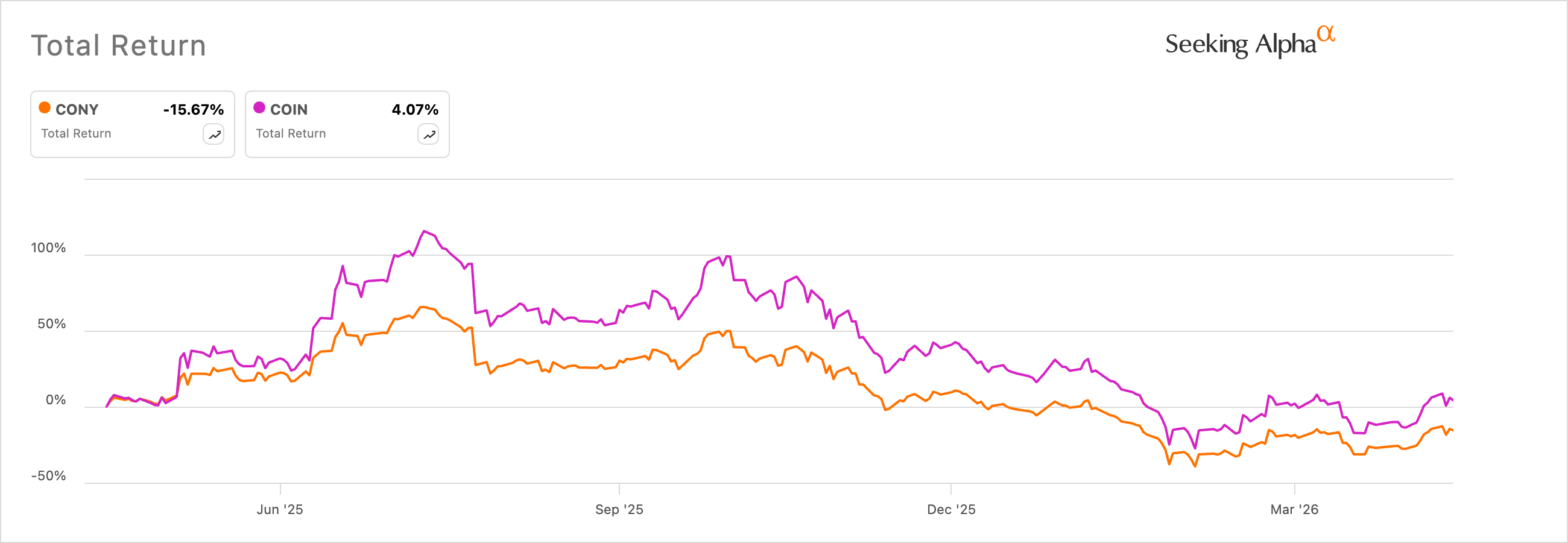
Other covered call ETFs demonstrate this. A good example of this is JEPQ, which tracks the Nasdaq 100 Index. Its total return over the last 12 months was 32%, as the Nasdaq 100 Index jumped 50%.
Therefore, most analysts recommend avoiding covered call ETFs. For one, in a bull market, their performance lags the underlying asset. In a bear market, their outperformance is usually not very large.
READ MORE: MSTR Stock Has Surged by 75%: Here’s Why and What to Expect