


The Roundhill Memory ETF (DRAM) is firing on all cylinders and ranks among the best-performing funds in terms of inflows this year. It has added over $10 billion since its launch in April, with its total assets under management (AUM) soaring to $15 billion.
Why the DRAM Stock Price is Soaring
The DRAM stock price has jumped by over 160% from its all-time low, making it one of the best performers in the US. This growth has been driven by the strong performance of its constituent companies. For example, Micron stock has jumped by 260%, while Sandisk, Seagate, and Western Digital have jumped by 602%, 230%, and 217%, respectively.
Other companies in the index have jumped sharply this year, with Samsung and SK Hynix soaring, with their market capitalization hitting over $1 trillion. This growth is occurring amid the ongoing artificial intelligence (AI) boom, which has led to a surge in demand for memory chips.
Most of these companies have reported strong financial results and issued bullish forward guidance, citing the ongoing demand and high prices. A good example of this is Micron, which entered the exclusive trillion-dollar club last week. Analysts expect its business to generate over $110 billion this financial year, followed by $175 billion next year.
Similarly, SanDisk’s revenue is expected to soar by 165% this year to $20 billion and by 115% next year to $42 billion. Western Digital’s revenue is expected to jump to $12.86 billion and $17 billion in the next two financial years.
Notably, despite their recent surges, these companies are among the cheapest on Wall Street. Micron trades at a forward P/E ratio of 17, while Sandisk has 27. Western Digital trades with a forward P/E ratio of 31. The S&P 500 Index has a multiple of 23.
READ MORE: Near Protocol Price Just Formed a Golden Cross: Here’s Why it May Surge Further
DRAM ETF Faces Major Risks Ahead
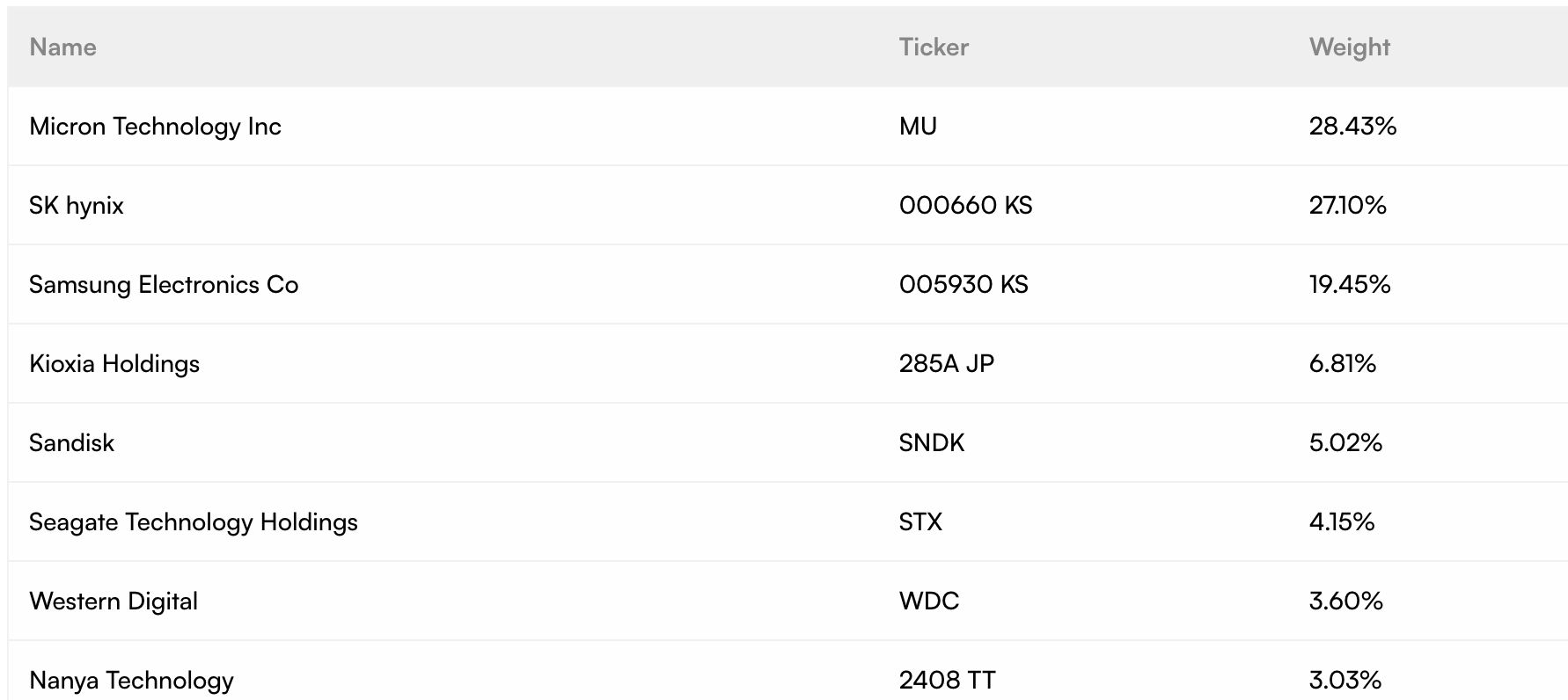
Still, the DRAM ETF faces some major risks ahead. First, Micron, SK Hynix, and Samsung account for 75% of its composition. Samsung and SK Hynix are South Korean companies. As such, there is a major risk that the fund will be impacted if one of these companies dives.
Second, there is a risk that the industry will move from undersupply to oversupply in the coming years. This will happen as these companies ramp up production to capitalize on soaring prices. This will lead to lower prices and a reversal in its performance.
Third, the ETF has become technically overbought, with the Relative Strength Index rising to 81 on the four-hour chart. It is common for highly overbought ETFs to go through a reversal as investors book profits.
READ MORE: Humanity Protocol Price, Funding Rate, Open Interest Are Soaring: Still a Buy?