



- The DRAM ETF stock has jumped to a record high this year.
- Its assets have jumped to a record high of over $12 billion.
- There is a risk that the stock will pullback in the near future.
The Roundhill Memory ETF (DRAM) has done well in the past few months, making it the fastest-growing funds on record. Launched in April this year, the fund has accumulated over $12 billion in assets, as the AI supercycle accelerates. DRAM stock jumped by 120% from its lowest point this year, as most of its constituent companies have soared to a record high.
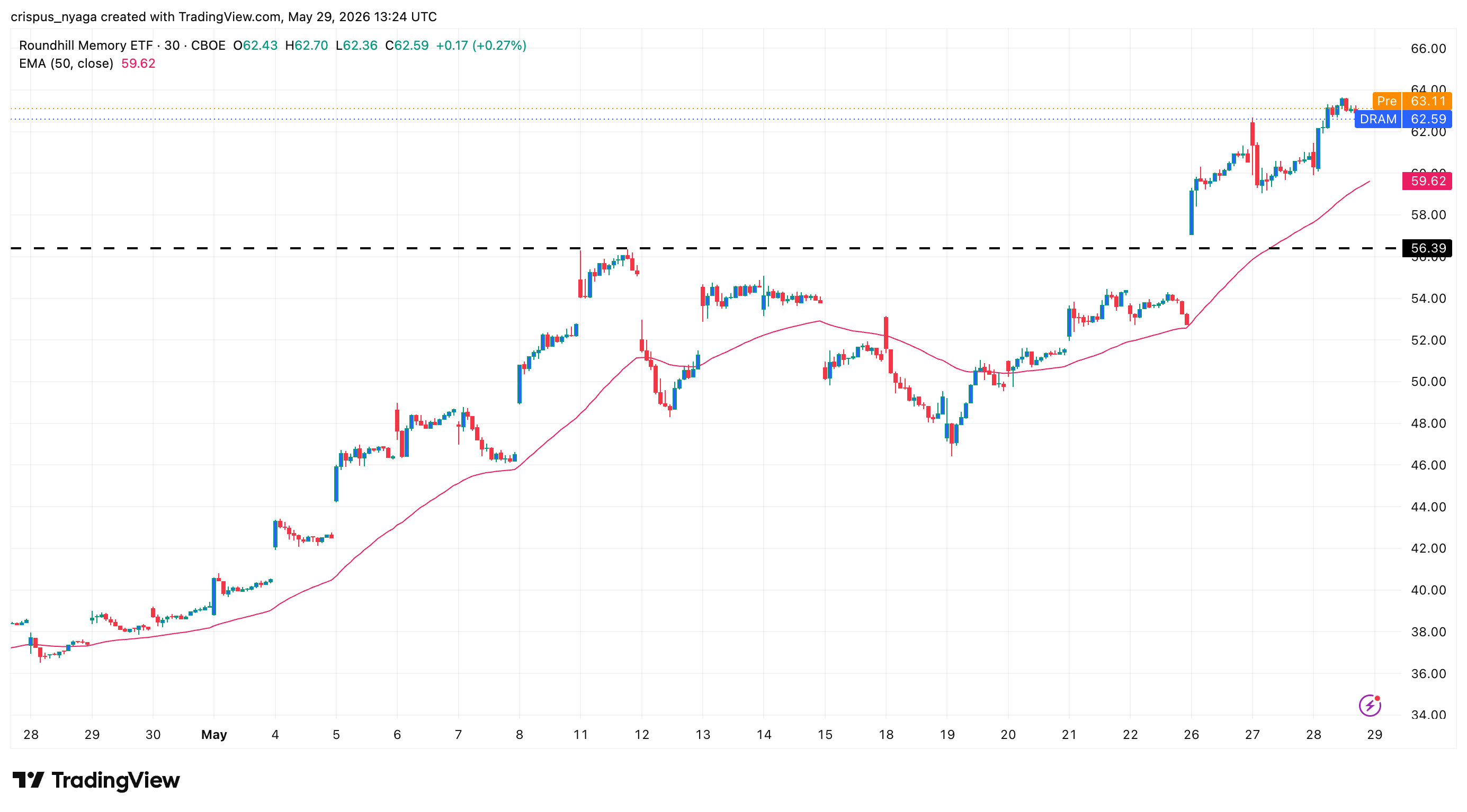
DRAM ETF Stock Has Jumped Amid the AI Supercycle
The Roundhill Memory ETF js is a top fund that aims to benefit from the ongoing AI supercycle that has pushed demand for memory chips to a record high.
Most companies in the industry have reported strong financial results this year, with some doubling their revenues on a quarter-on-quarter (QoQ) basis. This growth happened as demand for memory chips and their prices continued soaring.
Analysts believe that this growth momentum will continue in the coming years, with most companies predicting double or even triple digit growth for the year. For example, the average estimate is that Micron will make $110 billion this year, up by 195% from the previous year.
READ MORE: Robinhood Stock Price is Soaring: Is HOOD Turning the Tide?
Similarly, analysts predict that Sandisk’s revenue will jump by 165% this year to over $19 billion this year, followed by $42 billion next year. Western Digital’s revenue is expected to jump by 35% this year to $12.86 billion followed by 36% to $25 billion next year.
Analysts are optimistic that demand for memory chips will continue soaring in the coming years as hyperscalers continue boosting their spending. For example, the top companies in the industry are expected to spend over $750 billion in capital spending this year, with some of these funds expected to go towards memory.
This growth explains why these memory stocks have soared this year, with Samsung, SK Hynix, and Micron achieving a $1 trillion market cap. Sandisk stock has soared to a record high, with its 12-month gains being over 4,100%. A $25,000 investment in the company 12 months ago has jumped to over $1 million.
Roundhill Memory ETF Faces Some Major Risks
Still, DRAM faces some major risks that may lead to its underperformance in the coming years. The most important one is concentration as three companies – SK Hynix, Micron, and Samsung – comprise a whopping 77% of its holdings. As a result, a sharp decline in one company will hurt its overall performance.
The other main risk is that this ETF, despite having 15 companies, is not diversified enough. The implication is that a major negative news, such as chip prices retreat will lead affect all of them. In other words, as these stocks have soared during the AI supercycle, chances are that they will retreat when it ends.
Additionally, there is always a risk of investing in companies that have diverged substantially from their historical averages. In most cases, this normally leads to a mean reversion, a situation where stocks retreat. Therefore, while the DRAM stock may continue rising, there is a risk that it will drop over time.
READ MORE: XRP Price Crashes to Key Support: Top Reasons a Rebound May Be Coming