


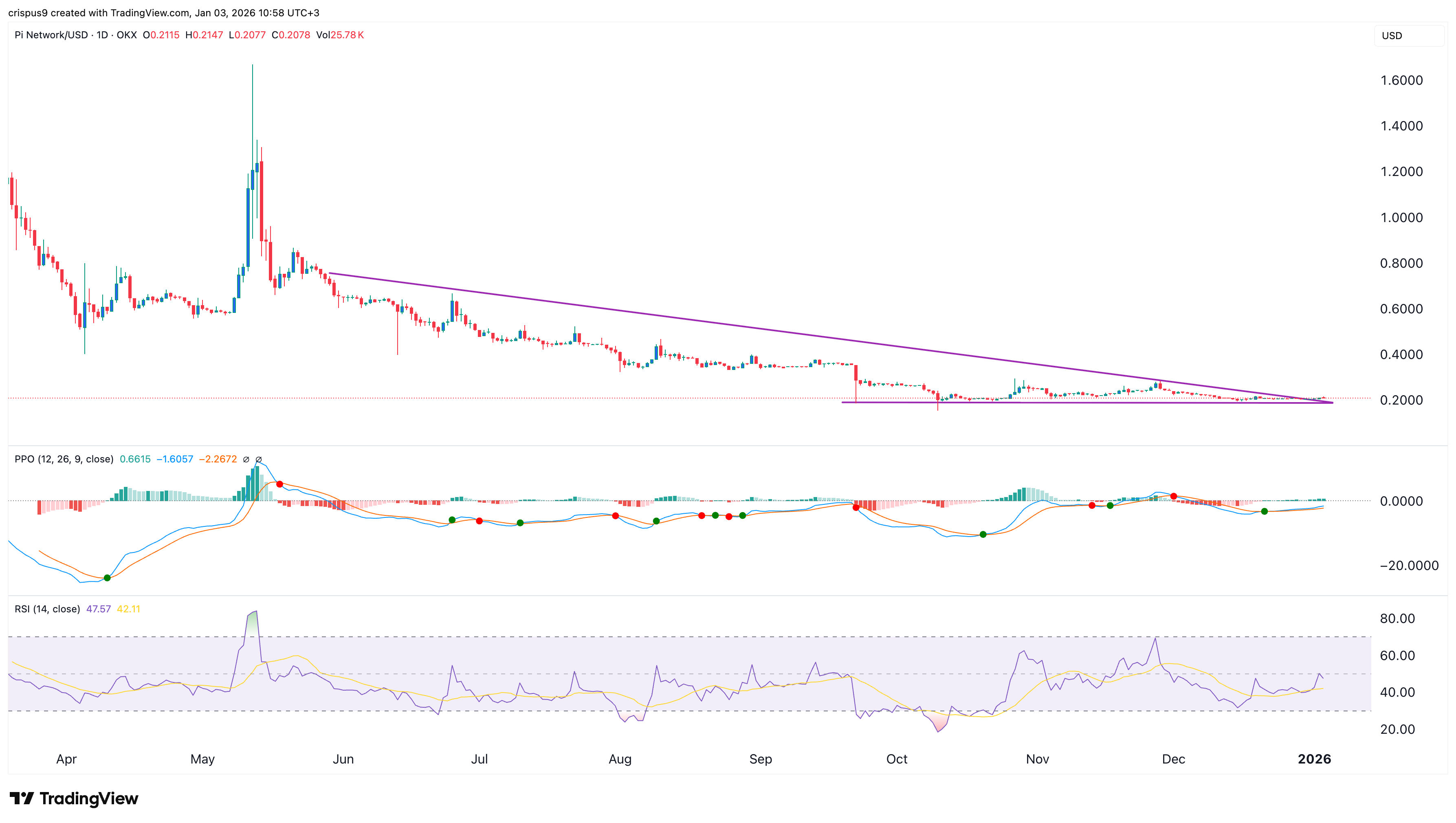
Pi Network price continues to consolidate as bulls stay on the sidelines and demand wanes. The token was trading at $0.2078 on Jan. 3, continuing a consolidation phase that began on Dec. 11. This article explores whether Pi Coin price will rebound in 2026.
Pi Network Price Technical Analysis Suggests a Rebound is Possible
The daily timeframe chart shows that the Pi Coin price has been moving sideways over the past few months. This performance was characterized by low investor demand, with daily volume falling below $20 million.
However, there are signs that the coin can still rebound this year even as its sentiment remains weak. One key sign is that the token has slowly formed a falling wedge pattern, shown in purple. Two downward-sloping, convergent trendlines characterize this pattern.
In a falling wedge pattern, a rebound usually happens when the two lines are nearing their confluence, which is happening now.
Meanwhile, there are signs that the coin is slowly forming a bullish divergence pattern. This pattern forms when oscillators make higher highs and higher lows.
In this case, the Percentage Price Oscillator (PPO) has made a bullish crossover, and its two lines are about to cross the zero line. The Relative Strength Index (RSI) has also pointed upwards and is about to cross the neutral point at 50.
READ MORE: Chainlink Price Prediction as Strategic LINK Reserve Buying Soars
Meanwhile, as we covered with the Zcash price, the token is now in the accumulation phase of the Wyckoff phase. This phase is characterized by low volume and sideways movements. It is then followed by the markup phase, where demand outweighs supply.
An asset typically moves from the accumulation phase to the markup phase when there is a catalyst. In Zcash’s case, the catalyst was Grayscale’s announcement of a ZEC fund.
Therefore, the risk-reward for Pi Coin price this year is favorable. If this happens, the token will likely rebound to the psychological $0.50 level, followed by the key $1 level.
The caveat, however, is that an asset can remain in the accumulation phase for years. In Zcash’s case, it remained in that stage between 2022 and 2025. Other tokens like Polkadot have stayed there for much longer than that.
Potential Catalysts for the Pi Coin Price in 2026
A few factors may help boost the Pi Network token this year. The most important one is that the crypto market needs to rally for altcoins like Pi to rebound. The token will remain under pressure if the crash continues this year.
Second, and most importantly, the developers need to list it on mainstream exchanges like Binance, Coinbase, and Upbit. Such a listing will push it much higher as millions of people buy it.
Third, the token will rebound if the ongoing initiatives work out. One of them is the upcoming launch of the decentralized exchange (DEX) and automated market maker (AMM) tools.
As we have seen with projects like IOTA, launching a product is one thing, and getting people to use it is another. While the launch may lead to an initial pop in the Pi Coin price, the rally’s durability will depend on whether it attracts more users.
One way to take it mainstream would be to launch it as an independent platform outside the Pi browser.
Additionally, Pi Core Team will need to solve the centralization issue, where they have all the control. Today, the obscure Pi Foundation holds over 90 billion tokens across hundreds of wallets, which may be why it has not been listed on major exchanges.
Additionally, the team should announce a Pi token measure to offset the daily unlocks. Recently, the UNI price jumped by double digits after the developers announced a 100-million-token burn.
Finally, Pi Network will need to exit from being a mere ghost chain into a utility chain. Besides, this is the main reason why Pi was created. The developer wanted to make it a more usable cryptocurrency than Bitcoin, which evolved into a store of value.
READ MORE: Altcoin Season Index Rises as Fear and Greed Gauge Nears Key Zone