


Polygon price has entered a local bear market as the recent bull run ended. POL, formerly known as MATIC, was trading at $0.1440 on Monday, down over 20% from its highest level this year. Still, there are a few reasons why the token will likely rebound once this retracement ends.
Polygon Price Technical Analysis Suggests a Rebound is Possible
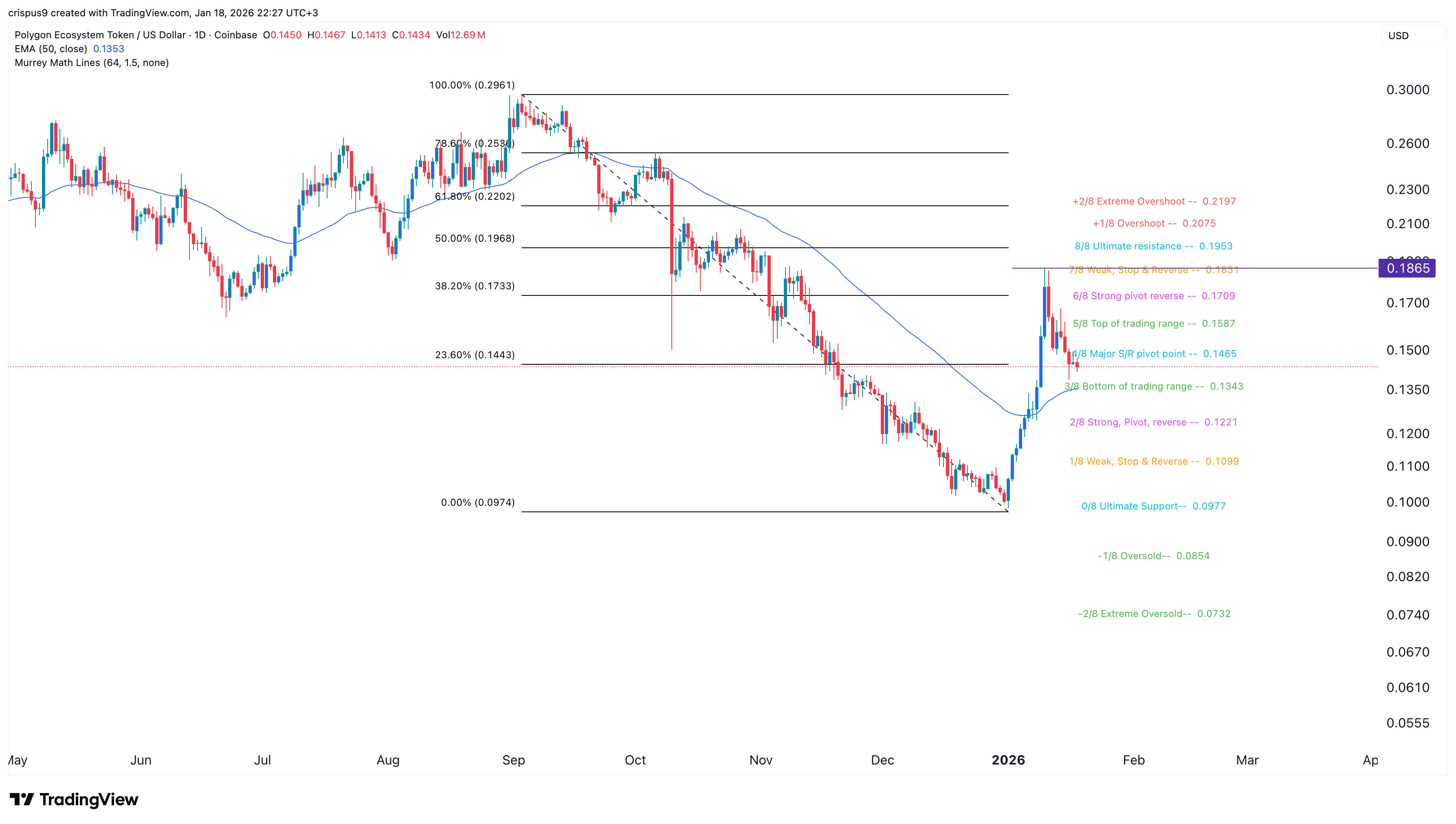
The first main reason Polygon’s price will rebound is its strong technical indicators. This chart shows that the token rebounded from a low of $0.097 on January 1st to a high of $0.1865.
It is common for a coin in a strong rally to retreat a bit before resuming the bullish trend. One reason for this is that it has likely entered the second phase of the Elliot Wave pattern. This second phase is usually corrective and is followed by the third, which is usually the longest.
POL price may move to this phase now that it has bottomed at the 23.60% Fibonacci Retracement level. Also, it remains above the 50-day Exponential Moving Average (EMA), a highly bullish technical indicator.
READ MORE: Dogecoin Price Forms an Alarming Pattern as DOGE ETF Inflows Dry
Additionally, the current price is along the Major S&R Pivot Point of the Murrey Math Lines tool. Therefore, the most likely scenario is where the token rebounds and initially moves to the year-to-date high of $0.1865. A move above that level will signal further gains, potentially to the psychological level at $0.25.
Polygon Network Growth and Token Burns
The other bullish case for Polygon price is its growing network, rising fees, and token burns. Data shows that the network had over 175 million transactions, up 8.5% from the same period a month earlier.
This transaction count makes it more active than other layer-2 and layer-1 networks in the industry. For example, Optimism handled over 85 million transactions, while Near Protocol, Sei, and Celo handled 112 million, 70 million, and 42 million, respectively.
Polygon has seen strong fee growth since the recent Madhuguri upgrade, which boosted its transaction speed to over 1,400 transactions per second (TPS). It also launched the Heimdall upgrade, which was related to the payment industry.
As a result, the network burns millions of POL tokens per week, making it highly deflationary. Unlike other cryptocurrencies, it has no token unlocks, meaning its circulating supply will continue to fall.
Polygon Has Tangible Utility
Meanwhile, unlike other crypto projects, Polygon has tangible use cases, which make it a major utility token. For example, Polygon powers Polymarket, one of the largest prediction marketplaces used by millions of people each month. Data shows that Polymarket handled over $2.7 billion in volume in the last 30 days alone.
Polygon is also used by some of the biggest fintech companies globally, including popular names like Stripe, Revolut, Shift4 Payments, and Mastercard. As a result, its stablecoin transaction volume has continued to rise over the past few months, a trend that will likely continue.
Polygon has continued to bet on the payments industry, and this month it acquired Coinme and Sequence, moves that made it a regulated company in the United States. These buyouts were part of its Open Money Stack, which aims to help companies enable seamless and interoperable on-chain stablecoin movement.
READ MORE: Bitcoin Price Prediction: Will BTC Hit $90k or $100k First?