



Bitcoin price continued its strong bearish trend on Friday morning as risks in the crypto market rose. BTC tumbled to $81,000, making it the worst-performing major asset. This article examines why the coin may continue to decline, given that it has formed major bearish patterns on the weekly chart.
Bitcoin Price Technical Analysis Points to a Plunge
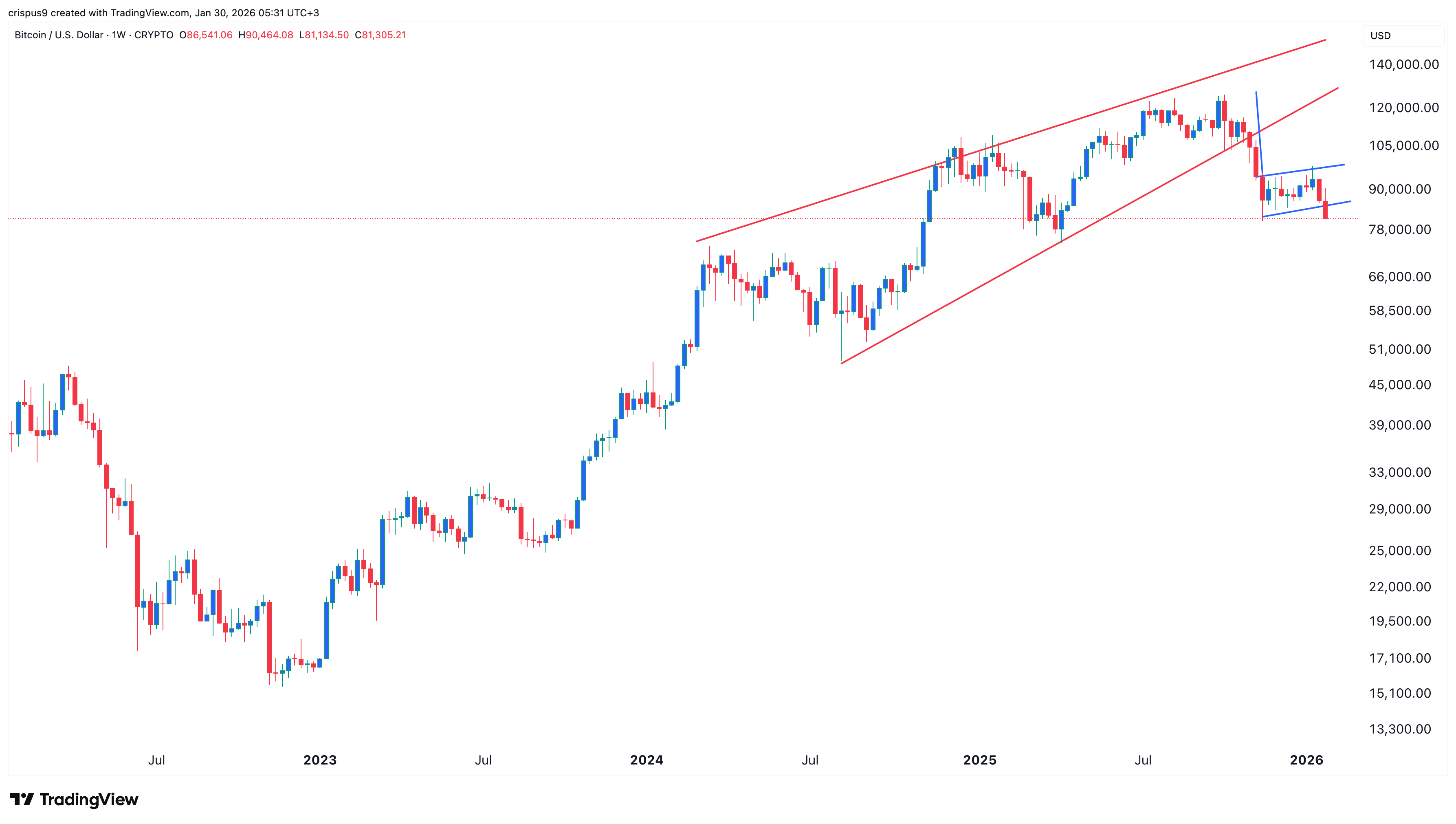
The weekly timeframe chart shows that the Bitcoin price has crashed from the all-time high of $126,300 to the current $81,950.
A closer look shows that some major bearish catalysts have happened. For example, it has formed a giant rising wedge chart pattern whose two lines neared their convergence in October last year.
Subsequently, the coin formed a bearish flag pattern, consisting of a vertical line and a channel. It has now moved below the lower side of the channel, confirming a bearish breakdown.
READ MORE: XRP Price Prediction: Is it a Buy as Ripple Lands at a Key Support?
The coin has moved below the 50-week Exponential Moving Average (EMA) and the Supertrend indicator. It also fell below the 38.2%Fibonacci Retracement level at $83,000.
Therefore, the most likely scenario is that the coin continues to fall as sellers target the next key support level at $70,250, its lowest level in April last year, and the 50% Fibonacci Retracement level.
Bitcoin’s rebound will only be confirmed if it moves above the key resistance levels at $97,865 and the psychological level at $100,000.
BTC Price Faces Major Risks
The ongoing Bitcoin price crash is attributable to several major risks. First, there is a risk that Donald Trump will appoint Kevin Warsh, who is crypto-skeptical, to be the next head of the Federal Reserve.
In reality, a Federal Reserve chair has no significant influence on the crypto industry. However, the narrative may harm the industry in the near term, as market participants had expected him to announce Rick Rieder, a well-known proponent of the industry.
The other major risk is that Trump is gearing up to attack Iran, a move that will have major implications, including rising geopolitical risks and higher crude oil prices. Higher prices may lead to greater inflation, making it more difficult for the Federal Reserve to cut interest rates.
Additionally, Bitcoin futures open interest has continued to fall over the past few days. It stood at $60 billion, down from the year-to-date high of over $66 billion. At the same time, Bitcoin liquidations have continued to soar over the past few days.
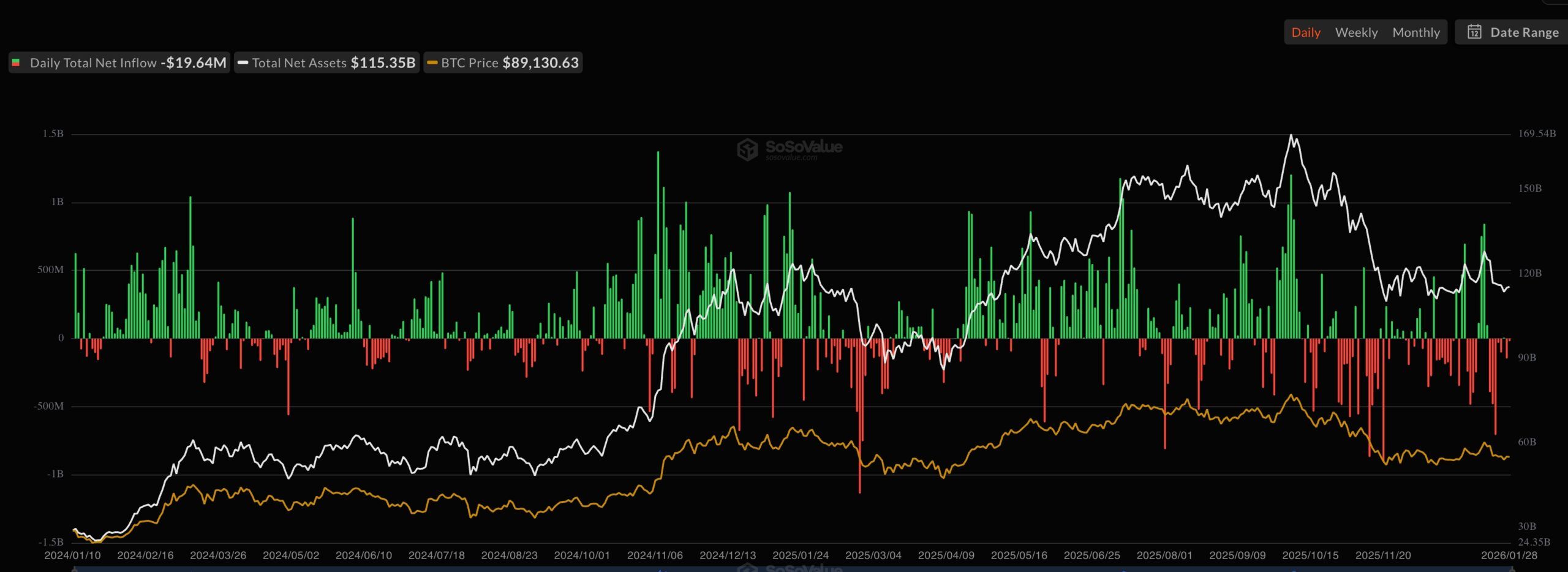
Demand for Bitcoin ETFs has continued to wane over the past few months. The funds have shed assets in the past three consecutive months, a trend that may continue in the coming weeks.
READ MORE: GME Stock Price Outlook: Reasons GameStop is Soaring and What Next