

Polygon price is up over 10% over the past 24 hours, trading at about $0.114, while the token remains down 46.48% over the past six months. The move unfolded within an intraday range of $0.10 to $0.116, with buyers stepping in after an extended downtrend. Trading volume climbed up nearly 79% day over day to $155.4 million. Flows into POL are aligning with a jump in network activity and a visible increase in token burns tied to usage.
Polygon Sees Heavy Network Activity as Burns and Payments Expand
In January, Polygon burned 25.7 million POL, marking the highest monthly burn since the network switched from MATIC to POL. This burn accounts for approximately 0.24% of the total supply and permanently removes tokens from circulation. With a total supply of nearly 10.58 billion POL, January’s reduction is small relative to daily trading volume, but it marks a directional shift.
READ MORE: XRP Price Prediction: Here’s Why Ripple May Crash to $1 Soon
Burns on Polygon are directly tied to transaction activity. Earlier in January, active addresses reached roughly 750,000 to 800,000 per day, according to data. Higher usage feeds directly into higher burns, tightening circulating supply over time and reducing background sell pressure.
Interestingly, the payment data reveals the source of much of this activity. In January 2026, Polygon-based projects processed more than 1.8 million payment transfers, a 523% increase from January 2025. Most transfers were between $10 and $100.
Stablecoins remain central to this growth. Polygon handled 282.1 million stablecoin transfers in January, up 28% from December and marking a fourth straight monthly record. USDC stablecoins alone moved $20.8 billion during the month, with total stablecoin volume reaching $29.8 billion. On the P2P side, Polygon recently recorded its second-highest weekly USDC transfer volume at $1.69 billion.
Alongside organic growth, Polygon is deepening its presence in regulated payments through the planned acquisitions of Coinme and Sequence, a combined $250 million deal aimed at building compliant stablecoin payroll and fiat ramps across 48 U.S. states. The strategy positions Polygon as a payments infrastructure, though traders appear to be treating the story as a longer-term theme rather than a fully priced catalyst.
POL Price Rebounds From $0.10 as Buyers Step Back In
On the 4-hour chart, the Polygon price has bounced back above its 9-period simple moving average at $0.106 after spending several days below its short-term trend indicators. The current price is at $0.114, testing the nearby resistance level at $0.1162.
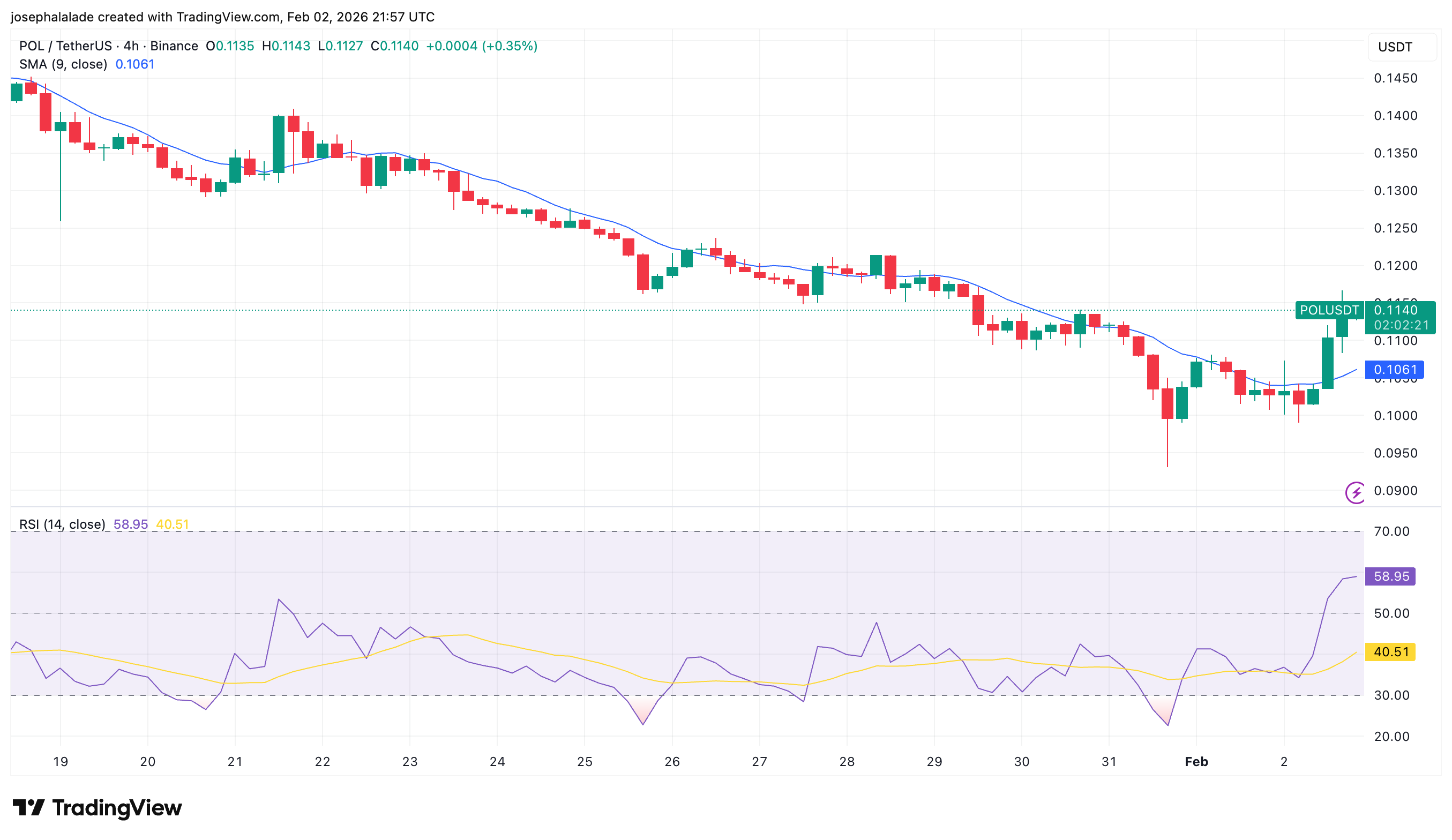
The 14-period RSI has risen to 58.9, breaking out of the oversold area and into the neutral-to-bullish area of the gauge. Momentum indicators show positive signs of improvement, but the higher-timeframe moving averages remain in sell mode.
Support sits near the psychological $0.10 level, where buyers previously absorbed heavy selling. A sustained hold above that area preserves the rebound structure. Failure to build acceptance above $0.116 would likely result in the price rotating back to or below the $0.10 zone.
For now, the Polygon price bounce is being driven more by usage-linked fundamentals and selective dip-buying than by broad trend reversal. Traders appear focused on whether February burn data and stablecoin volumes can hold near January’s pace.
READ MORE: Tether Releases Open-Source Mining Software to Broaden Bitcoin Access