


Tesla stock price has remained under pressure this year, moving from a high of $500 in December last year to the current $417. Its market capitalization declined from a record high of $1.69 trillion to $1.57 trillion. This article explores why the stock may have a strong bearish breakdown after forming a risky pattern.
Tesla Stock Price Has Formed a Risky Pattern
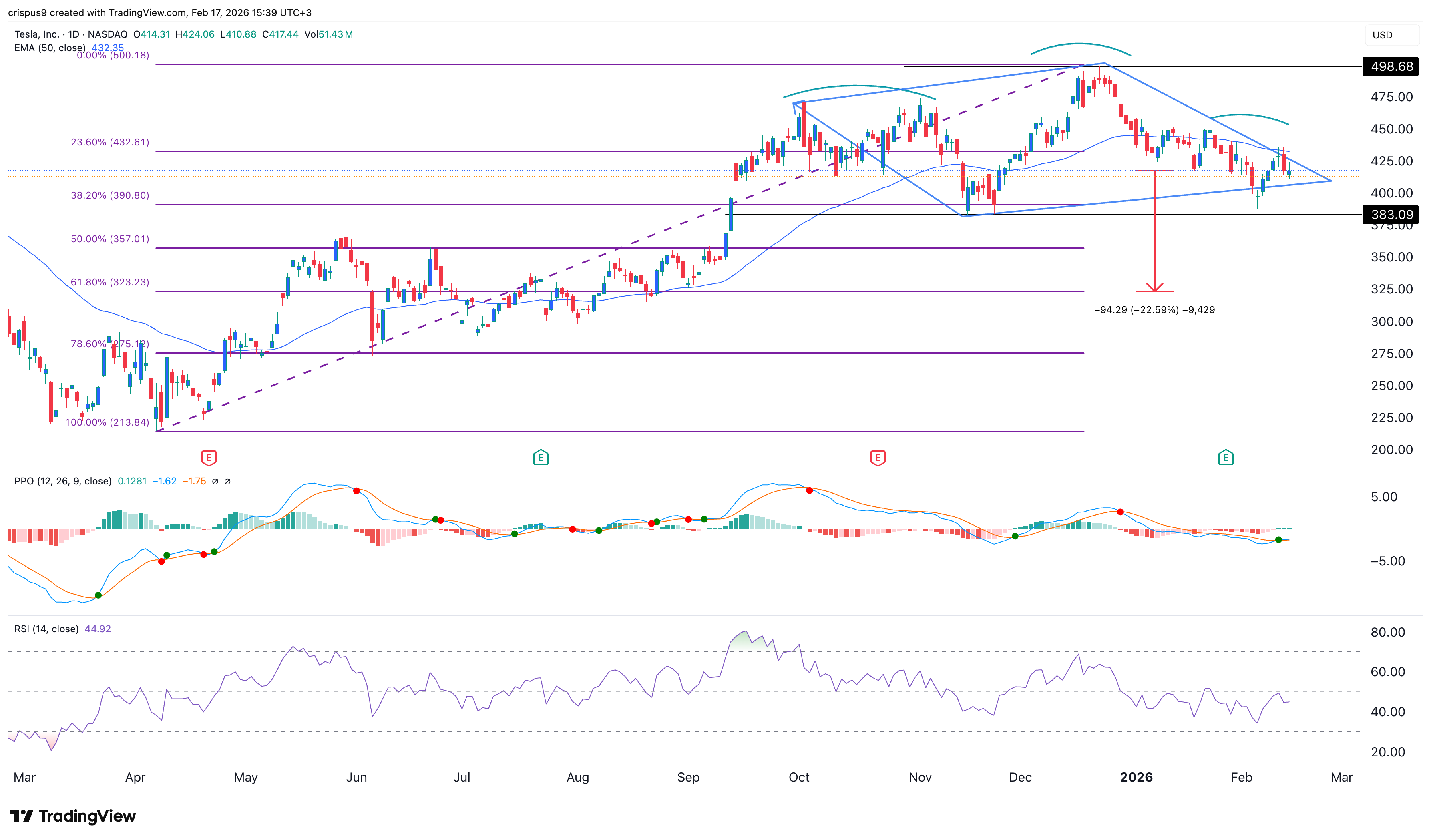
The daily timeframe chart shows that the TSLA stock has formed a major risky chart pattern that could trigger a bearish breakdown in the near term.
Tesla has formed a head-and-shoulders pattern, with the neckline at the 38.2% Fibonacci Retracement level at $390. It has also remained below the 50-day and 100-day Exponential Moving Averages (EMAs) and the Supertrend indicator, indicating that bears are in control.
READ MORE: Solana Price Prediction: Growth Continues, But Risks Point to $50 Decline
Tesla has also formed an island reversal pattern, which is shown in blue. At the same time, the Relative Strength Index (RSI) and the Percentage Price Oscillator (PPO) have continued falling.
Therefore, the most likely TSLA stock outlook is bearish, with the initial target being the neckline at $383.
A move below that level will indicate further downside, potentially to the 50% Fibonacci Retracement at $357, approximately 15% below the current level. It may also drop by 22% to the 61.8% retracement level at $323.
Tesla is Facing Major Headwinds as it Pivots to AI
Fundamentally, Tesla is facing major headwinds as its core business continues to slow down in the United States and other markets. The most recent results showed that Tesla’s automotive revenue dropped by 11% in the fourth quarter to $17.6 billion.
This retreat was offset by the 25% growth in its energy generation and storage revenue and the 18% jump in its services and other revenue.
Tesla’s vehicles will continue to struggle now that competitors have closed the gap. For example, companies such as Nio, XPeng, and BYD are dominant in China, while key markets such as Europe and Canada are reducing tariffs on Chinese automakers.
It is against this backdrop that Tesla has pivoted its business to other industries like artificial intelligence, robotics, and taxis. Its AI ventures include full self-driving capabilities, Optimus humanoid robots, and robotaxi services. Elon Musk has indicated that the company will begin developing AI chips.
The challenge, however, is that it remains unclear whether this expansion will lead to further revenue growth. For example, humanoid robots are likely to be niche products that cannot substitute for the slowing vehicle industry.
Additionally, the robo taxi industry faces substantial competition from companies such as Waymo, and its future profitability remains uncertain.
Notably, Tesla has launched major flops in the past, with the most prominent being the Tesla Semi and the Cybertruck. Additionally, its much-hyped roadster, unveiled in 2019, has never been launched.
Tesla is still one of the most overvalued companies on Wall Street, with a forward price-to-earnings ratio of 202, much higher than the sector median of 17. In contrast, Ford, a large automaker, has a multiple of 9.2, while General Motors has a multiple of 6.
READ MORE: Bitcoin Price Prediction as Scott Ritter Predicts Trump Iran Attack