


- BlackRock is planning to launch the iShares Bitcoin Premium Income ETF (BITA).
- The fund’s goal will be to give investors access to Bitcoin and a monthly dividend.
- History shows that covered call ETFs don't outperform the underlying asset in terms of total return by much.
BlackRock, the biggest asset manager in the world, and the owner of the biggest Bitcoin ETF, is planning to launch a new fund that will pay investors a monthly payout to investors. This article explores how BITA ETF will work and whether it will be a good investment.
BITA ETF to Pay a Big Dividend to Investors Using Covered Call Strategy
A key limit to the iShares Bitcoin ETF (IBIT) is that it does not pay investors any monthly return because it holds just Bitcoin. Still, it has become the biggest crypto fund in the world with over $52 billion in assets.
BlackRock is now working on the iShares Bitcoin Premium Income ETF (BITA), which will pay investors a big monthly dividend.
BITA will derive its monthly return from a process known as covered call strategy. At its simplest form, a covered call ETF works by buying an asset and then selling or writing calls.
A call is a transaction that gives an investor the right, but not the obligation, to buy an asset at a predetermined price by a specific expiration period. In this case, BlackRock may decide to base the BITA ETF on Bitcoin or IBIT.
By executing this transaction, the ETF receives a premium, which it uses to distribute to investors as dividends. The fund also invests some of the money in government bonds and receives a yield.
READ MORE: SoFi Stock Price is Down 50% Since November: Time to Buy the Dip?
A covered call ETF transaction has three main outcomes. First, if the underlying asset falls, the call option becomes worthless as the investor can buy it in the open market. In this case, the ETF retains the premium, which helps to offset the decline.
If the asset jumps, the ETF benefits from the gains and the premium. However, gains can be limited, especially when the asset jumps sharply above the strike price.
The other outcome is when the asset remains in flat during this process. In this case, the investor benefits from taking the premium payment.
Will the iShares Bitcoin Premium ETF be a Better Buy Than IBIT?
A common question among investors is whether a covered call ETF is a better investment than the underlying asset. In this case, investors will be torn between investing in IBIT, which offers no monthly return, or BITA, which benefits from Bitcoin’s appreciation while giving out a monthly return.
The best approach for investors to measure the success of an asset is to look at the total return, which considers the dividend and the price appreciation.
In this case, the best way to look at it is to compare Bitcoin’s performance with that of the NEOS Bitcoin High Income ETF (BTCI), which has accumulated over $950 million in assets, thanks to its 27% distribution rate.
Data shows that the BTCI stock has dropped by 29.8% in the last 12 months, while IBIT has dropped by 11.6% in the same period.
However, when dividends are introduced, a change happens. IBIT’s total return was minus 11.6%, while BTCI has dropped by just 7.4%. In this case, we see that the BTCI stock was a better investment as the Bitcoin price dropped.
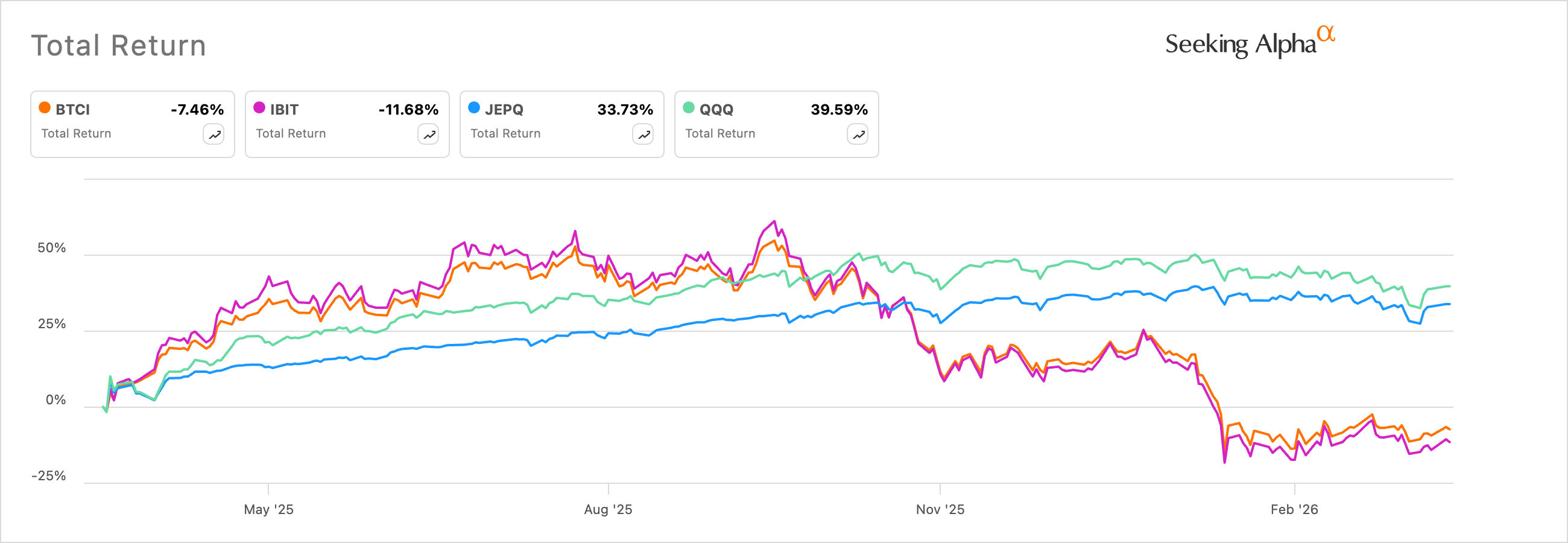
However, historically, data show that the returns of covered call ETFs are not all that superior to their underlying assets. A good example of this is the JPMorgan Nasdaq Equity Premium Income ETF (JEPQ), which tracks the Nasdaq 100 Index. As the chart above shows, JEPQ ETF has returned 33% in the last 12 months compared to Invesco QQQ’s 39%.
On top of this, covered call ETFs are actively managed, meaning that they always charge a higher expense ratio. BTCI charges an expense ratio of 0.98%, while the upcoming Morgan Stanley Bitcoin ETF will charge just 0.14%.
Therefore, if you strongly believe that Bitcoin price will stage a comeback, analysts recommend buying and holding it instead of the existing and upcoming covered call ETFs.
READ MORE: Top Reasons Palantir Stock is Stuck in a Bear Market and What Next